Periodically I give talks to high school and college students about my time in Vietnam. My format is simple. A very brief intro, followed by an eight minute clip from The Real Deal, a professionally edited short film I wrote twenty-five years ago. The students, many of whom have read The Things They Carried, by Tim O’Brien, are unprepared for the rapid imagery, the relentless prose, the tone of my voice not always pleasant. “Can we have the lights on please,” reveals a sea of stunned faces.
Next, sustaining the flow, projected onto a large screen, a slideshow of photographs taken by myself or a squad mate of the men in my platoon. On each I mention small details or tell a brief story.
 “That’s Ed Torres. He walked point. Once, while we were taking a break on patrol his shotgun went off and nearly killed me.”
“That’s Bill William’s. He was killed by friendly fire.”And I tell of the ambush and how it happened.
“…under my knees those are leech straps. We wore them to keep the leeches from crawling up to our private parts.”
“That’s my replacement. I had a bad feeling about him.” And I tell how the man who looked like his name botched a medevac and Skinny Bob and Ken, hoisted upside down, bled to death.
“That’s Captain Leland Hyslop, our commander. Look at him. He loved combat. Lived for it. He passed away in 2023.”
I linger at each slide only a minute or two, until “Next slide, please.” The last ten minutes reserved for questions.
It’s always a challenge to tell the truth, not embellish or sugarcoat what we did, what was done to us, what lay ahead. And I try, not always succeeding, to keep my anger and loss and evident sorrow, my anxiety, my ptsd, in check.
Below are student responses to a recent talk I gave at a community college in Boston.
Eric
Upon watching the interview Marc Levy did with Salem Digest, a part that really surprised me was the possibility of American troops accidentally becoming their own enemy. In one part of the interview Marc recalls having a nightmare while sleeping 4 feet away from his friend Jerry, lying head to toe. He says “that night I slept with all my ammo on, my 45 and my M-16,” then describes “in the nightmare, the NVA have gotten past the perimeter and they’re crawling towards me.” He woke up from the nightmare, saw feet next to him, and says, “I take out my 45, I pull the hammer back and I pointed it at these feet.” Then the moon came out and he saw that the tread on the boot was American, realizing it wasn’t the enemy.
He also mentioned something called an “All American” [American troops shooting at each other, thinking it’s the enemy]. During one of these, Marc says 2 platoons went out on patrol in opposing directions and ended up running into each other and started shooting. After hearing these stories, I hadn’t considered the possibilities of American troops unknowingly becoming enemies to themselves in the war; hearing this was really interesting to me. From waking up after a nightmare about the enemy with your comrade sleeping next to you, to troops shooting at their allies thinking it’s the enemy, this really opened my eyes to some dangers of war that I hadn’t considered!
Yulia
After Marc Levy’s presentation I stopped by to tell him how much I enjoyed it, even though I wasn’t sure if it was the right and appropriate word. The way he spoke about his late friends deeply touched me: I told him that seeing these pictures of handsome young men with warm smiles was heartbreaking.
Honestly, during his presentation, I got so emotional, not just because of his stories, but his eyes were so full of this tragedy. Growing up, we used to have some WWII veterans coming to school to talk to kids about the experience they had; they almost never spoke about the war fields but always had funny stories to share, with tears in their eyes. Probably a famous fact, but in Russia we still massively celebrate Victory Day with parades, and we call it “a holiday with tears.” I’ve always cried on the 9th of May, and that’s why I was deeply affected by Marc Levy’s presentation. I think the eyes of people who survived something catastrophic are scary to look at because you feel impossible small to their experience.
I asked him a question whether there were some people who were strong patriots and really believed in what they fought for, and whether some soldiers had political arguments. His reply deeply stunned me: everyone wanted to survive. He remembered only one situation like that but in general their main goal was to come back home alive.
Camila
I liked his speech overall but there were some things that stuck out to me. When he mentioned that during the war in the middle of the jungle they would bring a priest in a helicopter and bring him down so he could pray for the soldiers, I understood when Marc Levy said he didn’t like those moments because he thought it was stupid because they would be so vulnerable by putting their equipment down and be off guard while listening to the prayer.
I could argue that from my point of view, as someone that believes in God, that it didn’t matter that they didn’t have their weapons on them, because they were having a moment with God, and what’s more powerful than God? They were being protected by God and that was enough, but I understand they are in a place where everything seems dangerous to them and they are also under so much fear it is hard for them to see beyond that.
I also loved all the stories he shared and how descriptive he was when talking about those moments that are not easy to remember because of the trauma. I really appreciated him coming to talk to us about his experience because I can understand that it could have brought back many feelings and memories that are hard to remember.
Yasmin
Something that surprised me during his presentation was the pictures he took. I would have never thought to bring a camera with me to war. It made me wonder what his reasoning was behind bringing it. Was it a hobby from before the war? Memory-keeping? Or was he thinking about the future historical aspect of the war? Also, seeing the soldiers and how young they were was really surprising. It was one thing to read about the draft ages and it was another to actually see how young they were. Not only were they young and drafted into the war but they were put in charge of each other like being medics. It was the young leading the young. That must’ve added to pressure and stress.
Something else that stuck out to me was when he said the US sent priests to give church services in the middle of the war. The situation sounds so jarring; to pause their fighting and be defenseless just for religion, and one that not everyone is a part of too. Since he talked about how he enlisted in the army, a question I would ask would be: what do you remember of the day you got to go back home from Vietnam?
Alexander
I’ve tried to condense this as much as I can, but this is still a long paragraph, sorry! Four things: First, I wondered how Marc Levy felt about talking to us. From the video, I sensed some anger, but that impression was filtered though my guilt at not having experienced war.
Second, the photos of the soldiers made them look like kids going to summer camp or something, except for the weapons. It made me more afraid than ever, thinking about who is making decisions during wars, how young soldiers can be, and the terrifying consequences of their actions on both themselves and others.
Third, a few times, Levy said: “He was a good soldier.” It sounded important to him, it felt like a phrase that he had brought with him from the past, and I’m not sure what he meant. Some of it was connected to leadership skills. Then, for one of the good soldiers, Levy provided an anecdote: the soldier did not panic during an ambush and methodically picked off the enemy. I imagine that a “good soldier” was many things to Levy, but that anecdote made me wonder if a good soldier was, in part, someone who was good at killing the enemy. Maybe he meant that the good soldier did not panic, or that he protected his fellow soldiers, but still, the fact that this meant being good at killing other people was just terrifying.
Finally, if I remember correctly, Levy said it took about 25 years to see people from Vietnam as people. That both made sense to me and made me despair. It emphasized to me how difficult it is to overcome indoctrination (“indoctrination” doesn’t quite capture what I mean, but I can’t think of a better word). It’s not something one can just be reasoned out of; it takes time and life experience.
Nguyen
Throughout Marc Levy’s presentation about his experience in the Vietnam/American War, his story felt very familiar in the sense that he remembered the memories with his fiends more than anything. I haven’t personally been in the army, but the way he narrated his story was similar to the way my Grandpa would speak about his journey with his friends [the Viet Minh] fighting French colonialization. One thing that stood out to me was his reason for joining the army. Although he enlisted to try something different, he highlighted that perhaps his patriotic motivation was curated with propaganda. This tactic gets used by many powers in the world to manipulate the way people respond to committing violence against others. One question I would ask Marc levy would be, would he choose to enlist in the war if he was aware of the true reason the U.S. provided for entering this war.
Sierra
Marc Levy’s presentation was meaningful to me because he shared personal experiences from the Vietnam War and talked about small moments that made the experience feel real. One thing that stood out was when he mentioned wanting quiet time during breaks, which felt very relatable because everyone sometimes needs space to think and recharge. Hearing him talk about those little details made the war feel more human rather than just something we read about in history. It was also really interesting to hear his perspective while we are reading The Things They Carried, especially the chapter Sweetheart of the Song Tra Bong, where medical people are also part of the story. Listening to someone who actually experienced the war made the reading feel more real and helped me better understand what people might have gone through.
What struck me most were the film clips and photographs of the Vietnam War; the images of the soldiers were so authentic that I couldn’t take my eyes off the screen. However, what truly stayed with me was reflecting on the profound loss and the lasting trauma war leaves on a soldier, regardless of which side they fought for—specifically how conditions like PTSD (post-war trauma) affect their ability to return to a normal life.
Although I have studied many documents about the war between the U.S. and Vietnam, there is a unique value in hearing from someone who actually lived through that era. I feel deeply grateful that he came to share those raw experiences with us. If I could ask him one more question, it would be: “If the U.S. had continued its occupation of South Vietnam, do you believe the North Vietnamese army could have still achieved victory?”
Elizabeta
Marc Levy’s presentation was very meaningful to me. When he talked about his friend and the day that happened [KIA], it felt very real and emotional. It didn’t feel like just a story from the past, but something that still lives with him even today. It surprised me how one single moment can change someone’s whole life. Listening to him also made me think about The Things They Carried, because soldiers do not only carry weapons or supplies, they also carry memories, loss, and the people they cared about. The part that stayed with me the most was how he still remembers his friend after so many years. It shows how powerful those experiences are. If I could ask him another question, I would ask how that day shaped the way he looks at life now.
Bethenney
One thing that was relevant to me about the presentation by Marc Levy was when he talked about his experiences in the war and how they still affect him today. Something that surprised me was when he said that he is always defensive and cannot turn his back on anyone. When I heard that, it made me think about the real consequences of war and how those experiences can stay with a person for the rest of their life. He also mentioned that he used to have many nightmares after the war, which shows how difficult those memories were for him. Another thing that surprised me was when he said that having braces could sometimes be a way for someone to avoid being sent to the army, which I didn’t know before. I found his talk very interesting and honest. If I could ask him another question now, I would ask him if he remembers the first time he had to kill someone during the war.
Nazanin
Marc Levy’s presentation captured the emotional depth of war. It is powerful how he focused on friendship and trust among soldiers, showing how those bonds are crucial in such demanding situations. The comparison to Tim O’Brien’s book and the idea of “things they carry” adds a meaningful layer, highlighting both the physical and emotional weight of war. He also pointed out an important truth about how war affects people deeply, often in ways that are hard to express or understand from the outside, just like it affected himself and his friends.
It is true that being in the army demands a lot—diligence, strength, and resilience, and takes an emotional toll that can change someone forever. Imagine them seeing the Vietnamese as animals, so they do not feel guilty killing them. This is how war changes human perception, not making them feel accountable for their actions.His reflection shows a good understanding of the complex realities soldiers face beyond just the battlefield.
One question I had: Considering all the experiences you went through during the war, how do you feel about women serving in the military?
Monique
Hearing a Vietnam veteran speak to the class and tell us his stories was an honor, and I am very appreciative of how much he was able to share with us. Seeing real life pictures of the soldiers and their conditions significantly improved my understanding of the reality of life in Vietnam. When he shared how anti-Vietnamese propaganda affected him and his journey unworking all the hate he was taught was heartbreaking! It takes a lot of courage to accept that you were wrong and acknowledge the wrong you’ve done–especially as a soldier who is expected to remain patriotic and not openly criticize the government.
I wish I had longer to ask him questions! Specifically, I would have liked to ask him if he felt that the U.S. government should apologize to all the victims of the Vietnam war, both Vietnamese citizens, veterans, and the Asian community. I cannot escape the feeling that everyone involved in the war was wronged and that as a nation we are again slipping into a war based on bias and hatred spread to benefit a small percent of the population.
_________________
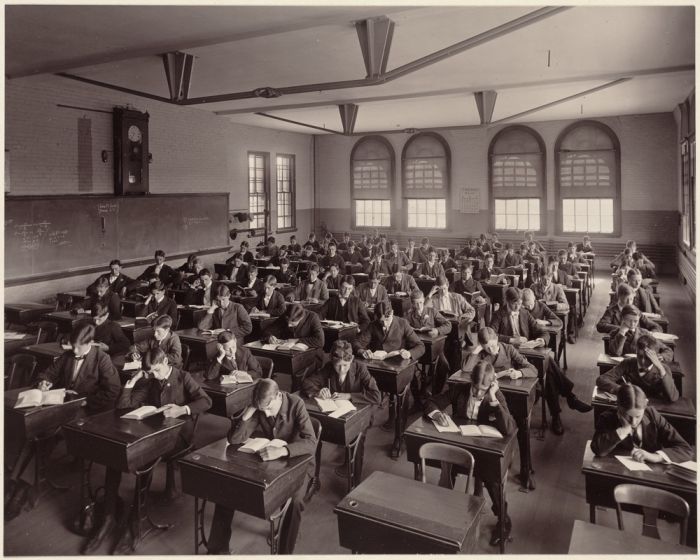
top image /Mechanic Arts High School, first year class, Roxbury 1899
photo: A. H. Folsom / Digital Commonwealth
Skinny Bob
Salem Digest interview
Medic’s interview with Bao Ninh
The Long Silence of Bao Ninh / Rohit Inani
The Dark Angry Secrets of Mike and Doc
Overrun in Cambodia
Overrun in Cambodia: Artillery Under Fire
Excavating LZ Ranch
Chieu Hoi leaflets: The Open Arm Program



Ruth’s Class
Periodically I give talks to high school and college students about my time in Vietnam. My format is simple. A very brief intro, followed by an eight minute clip from The Real Deal, a professionally edited short film I wrote twenty-five years ago. The students, many of whom have read The Things They Carried, by Tim O’Brien, are unprepared for the rapid imagery, the relentless prose, the tone of my voice not always pleasant. “Can we have the lights on please,” reveals a sea of stunned faces.
Next, sustaining the flow, projected onto a large screen, a slideshow of photographs taken by myself or a squad mate of the men in my platoon. On each I mention small details or tell a brief story.
“That’s Bill William’s. He was killed by friendly fire.”And I tell of the ambush and how it happened.
“…under my knees those are leech straps. We wore them to keep the leeches from crawling up to our private parts.”
“That’s my replacement. I had a bad feeling about him.” And I tell how the man who looked like his name botched a medevac and Skinny Bob and Ken, hoisted upside down, bled to death.
“That’s Captain Leland Hyslop, our commander. Look at him. He loved combat. Lived for it. He passed away in 2023.”
I linger at each slide only a minute or two, until “Next slide, please.” The last ten minutes reserved for questions.
It’s always a challenge to tell the truth, not embellish or sugarcoat what we did, what was done to us, what lay ahead. And I try, not always succeeding, to keep my anger and loss and evident sorrow, my anxiety, my ptsd, in check.
Below are student responses to a recent talk I gave at a community college in Boston.
Eric enemy. In one part of the interview Marc recalls having a nightmare while sleeping 4 feet away from his friend Jerry, lying head to toe. He says “that night I slept with all my ammo on, my 45 and my M-16,” then describes “in the nightmare, the NVA have gotten past the perimeter and they’re crawling towards me.” He woke up from the nightmare, saw feet next to him, and says, “I take out my 45, I pull the hammer back and I pointed it at these feet.” Then the moon came out and he saw that the tread on the boot was American, realizing it wasn’t the enemy.
Upon watching the interview Marc Levy did with Salem Digest, a part that really surprised me was the possibility of American troops accidentally becoming their own
He also mentioned something called an “All American” [American troops shooting at each other, thinking it’s the enemy]. During one of these, Marc says 2 platoons went out on patrol in opposing directions and ended up running into each other and started shooting. After hearing these stories, I hadn’t considered the possibilities of American troops unknowingly becoming enemies to themselves in the war; hearing this was really interesting to me. From waking up after a nightmare about the enemy with your comrade sleeping next to you, to troops shooting at their allies thinking it’s the enemy, this really opened my eyes to some dangers of war that I hadn’t considered!
Yulia
After Marc Levy’s presentation I stopped by to tell him how much I enjoyed it, even though I wasn’t sure if it was the right and appropriate word. The way he spoke about his late friends deeply touched me: I told him that seeing these pictures of handsome young men with warm smiles was heartbreaking.
Honestly, during his presentation, I got so emotional, not just because of his stories, but his eyes were so full of this tragedy. Growing up, we used to have some WWII veterans coming to school to talk to kids about the experience they had; they almost never spoke about the war fields but always had funny stories to share, with tears in their eyes. Probably a famous fact, but in Russia we still massively celebrate Victory Day with parades, and we call it “a holiday with tears.” I’ve always cried on the 9th of May, and that’s why I was deeply affected by Marc Levy’s presentation. I think the eyes of people who survived something catastrophic are scary to look at because you feel impossible small to their experience.
I asked him a question whether there were some people who were strong patriots and really believed in what they fought for, and whether some soldiers had political arguments. His reply deeply stunned me: everyone wanted to survive. He remembered only one situation like that but in general their main goal was to come back home alive.
Camila
I liked his speech overall but there were some things that stuck out to me. When he mentioned that during the war in the middle of the jungle they would bring a priest in a helicopter and bring him down so he could pray for the soldiers, I understood when Marc Levy said he didn’t like those moments because he thought it was stupid because they would be so vulnerable by putting their equipment down and be off guard while listening to the prayer.
I could argue that from my point of view, as someone that believes in God, that it didn’t matter that they didn’t have their weapons on them, because they were having a moment with God, and what’s more powerful than God? They were being protected by God and that was enough, but I understand they are in a place where everything seems dangerous to them and they are also under so much fear it is hard for them to see beyond that.
I also loved all the stories he shared and how descriptive he was when talking about those moments that are not easy to remember because of the trauma. I really appreciated him coming to talk to us about his experience because I can understand that it could have brought back many feelings and memories that are hard to remember.
Yasmin Or was he thinking about the future historical aspect of the war? Also, seeing the soldiers and how young they were was really surprising. It was one thing to read about the draft ages and it was another to actually see how young they were. Not only were they young and drafted into the war but they were put in charge of each other like being medics. It was the young leading the young. That must’ve added to pressure and stress.
Something that surprised me during his presentation was the pictures he took. I would have never thought to bring a camera with me to war. It made me wonder what his reasoning was behind bringing it. Was it a hobby from before the war? Memory-keeping?
Something else that stuck out to me was when he said the US sent priests to give church services in the middle of the war. The situation sounds so jarring; to pause their fighting and be defenseless just for religion, and one that not everyone is a part of too. Since he talked about how he enlisted in the army, a question I would ask would be: what do you remember of the day you got to go back home from Vietnam?
Alexander
I’ve tried to condense this as much as I can, but this is still a long paragraph, sorry! Four things: First, I wondered how Marc Levy felt about talking to us. From the video, I sensed some anger, but that impression was filtered though my guilt at not having experienced war.
Second, the photos of the soldiers made them look like kids going to summer camp or something, except for the weapons. It made me more afraid than ever, thinking about who is making decisions during wars, how young soldiers can be, and the terrifying consequences of their actions on both themselves and others.
Third, a few times, Levy said: “He was a good soldier.” It sounded important to him, it felt like a phrase that he had brought with him from the past, and I’m not sure what he meant. Some of it was connected to leadership skills. Then, for one of the good soldiers, Levy provided an anecdote: the soldier did not panic during an ambush and methodically picked off the enemy. I imagine that a “good soldier” was many things to Levy, but that anecdote made me wonder if a good soldier was, in part, someone who was good at killing the enemy. Maybe he meant that the good soldier did not panic, or that he protected his fellow soldiers, but still, the fact that this meant being good at killing other people was just terrifying.
Finally, if I remember correctly, Levy said it took about 25 years to see people from Vietnam as people. That both made sense to me and made me despair. It emphasized to me how difficult it is to overcome indoctrination (“indoctrination” doesn’t quite capture what I mean, but I can’t think of a better word). It’s not something one can just be reasoned out of; it takes time and life experience.
Nguyen War, his story felt very familiar in the sense that he remembered the memories with his fiends more than anything. I haven’t personally been in the army, but the way he narrated his story was similar to the way my Grandpa would speak about his journey with his friends [the Viet Minh] fighting French colonialization. One thing that stood out to me was his reason for joining the army. Although he enlisted to try something different, he highlighted that perhaps his patriotic motivation was curated with propaganda. This tactic gets used by many powers in the world to manipulate the way people respond to committing violence against others. One question I would ask Marc levy would be, would he choose to enlist in the war if he was aware of the true reason the U.S. provided for entering this war.
Throughout Marc Levy’s presentation about his experience in the Vietnam/American
Sierra
Marc Levy’s presentation was meaningful to me because he shared personal experiences from the Vietnam War and talked about small moments that made the experience feel real. One thing that stood out was when he mentioned wanting quiet time during breaks, which felt very relatable because everyone sometimes needs space to think and recharge. Hearing him talk about those little details made the war feel more human rather than just something we read about in history. It was also really interesting to hear his perspective while we are reading The Things They Carried, especially the chapter Sweetheart of the Song Tra Bong, where medical people are also part of the story. Listening to someone who actually experienced the war made the reading feel more real and helped me better understand what people might have gone through.
Although I have studied many documents about the war between the U.S. and Vietnam, there is a unique value in hearing from someone who actually lived through that era. I feel deeply grateful that he came to share those raw experiences with us. If I could ask him one more question, it would be: “If the U.S. had continued its occupation of South Vietnam, do you believe the North Vietnamese army could have still achieved victory?”
Elizabeta and the day that happened [KIA], it felt very real and emotional. It didn’t feel like just a story from the past, but something that still lives with him even today. It surprised me how one single moment can change someone’s whole life. Listening to him also made me think about The Things They Carried, because soldiers do not only carry weapons or supplies, they also carry memories, loss, and the people they cared about. The part that stayed with me the most was how he still remembers his friend after so many years. It shows how powerful those experiences are. If I could ask him another question, I would ask how that day shaped the way he looks at life now.
Marc Levy’s presentation was very meaningful to me. When he talked about his friend
Bethenney
 One thing that was relevant to me about the presentation by Marc Levy was when he talked about his experiences in the war and how they still affect him today. Something that surprised me was when he said that he is always defensive and cannot turn his back on anyone. When I heard that, it made me think about the real consequences of war and how those experiences can stay with a person for the rest of their life. He also mentioned that he used to have many nightmares after the war, which shows how difficult those memories were for him. Another thing that surprised me was when he said that having braces could sometimes be a way for someone to avoid being sent to the army, which I didn’t know before. I found his talk very interesting and honest. If I could ask him another question now, I would ask him if he remembers the first time he had to kill someone during the war.
Nazanin
 Marc Levy’s presentation captured the emotional depth of war. It is powerful how he focused on friendship and trust among soldiers, showing how those bonds are crucial in such demanding situations. The comparison to Tim O’Brien’s book and the idea of “things they carry” adds a meaningful layer, highlighting both the physical and emotional weight of war. He also pointed out an important truth about how war affects people deeply, often in ways that are hard to express or understand from the outside, just like it affected himself and his friends.
It is true that being in the army demands a lot—diligence, strength, and resilience, and takes an emotional toll that can change someone forever. Imagine them seeing the Vietnamese as animals, so they do not feel guilty killing them. This is how war changes human perception, not making them feel accountable for their actions.His reflection shows a good understanding of the complex realities soldiers face beyond just the battlefield.
One question I had: Considering all the experiences you went through during the war, how do you feel about women serving in the military?
Monique
Hearing a Vietnam veteran speak to the class and tell us his stories was an honor, and I am very appreciative of how much he was able to share with us. Seeing real life pictures of the soldiers and their conditions significantly improved my understanding of the reality of life in Vietnam. When he shared how anti-Vietnamese propaganda affected him and his journey unworking all the hate he was taught was heartbreaking! It takes a lot of courage to accept that you were wrong and acknowledge the wrong you’ve done–especially as a soldier who is expected to remain patriotic and not openly criticize the government.
I wish I had longer to ask him questions! Specifically, I would have liked to ask him if he felt that the U.S. government should apologize to all the victims of the Vietnam war, both Vietnamese citizens, veterans, and the Asian community. I cannot escape the feeling that everyone involved in the war was wronged and that as a nation we are again slipping into a war based on bias and hatred spread to benefit a small percent of the population.
_________________
top image /Mechanic Arts High School, first year class, Roxbury 1899
photo: A. H. Folsom / Digital Commonwealth
Skinny Bob
Salem Digest interview
Medic’s interview with Bao Ninh
The Long Silence of Bao Ninh / Rohit Inani
The Dark Angry Secrets of Mike and Doc
Overrun in Cambodia
Overrun in Cambodia: Artillery Under Fire
Excavating LZ Ranch
Chieu Hoi leaflets: The Open Arm Program