 I was born in Sweden in 1943. After dropping out of high school I held odd jobs, mostly underground mines in Sweden. The Swedish army drafted me in the summer of 1965. I served my obligatory ten months primarily in an infantry platoon. I liked it and excelled in Swedish peace time soldiering. In early 1966, in a movie theater in Stockholm, I watched and was fascinated by The 317th Platoon, a French Indochina war film considered one of the finest war movies ever made. I followed the news stories about the escalating American war in Vietnam. Honorably discharged from the Swedish army in April 1966, I decided to volunteer to fight in the Vietnam war. I was young and vigorous. I wanted adventure, a challenge, and I truly believed I would not be seriously wounded or killed in action.
After 14 months and many obstacles, and living for close to a year in Liberia, where I got my Green Card, I arrived at JFK airport in New York. That same day I went to the recruiting station at Times Square, where three weeks later I signed up for two years with the Marines. I arrived at Parris Island in mid-June 1967. I did well in boot camp. Actually, I excelled in the rigorous training, the skills we were taught. Six months later, on Christmas Eve, I arrived in Vietnam. What a Christmas present!
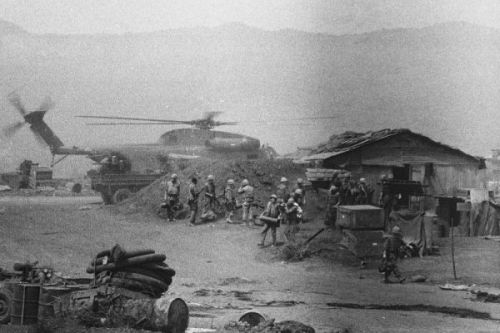
Within a few days I was flown to the 26th Marines at the very remote and isolated Khe Sanh Combat Base (KSCB), located near the Laotian border and the DMZ. The weather was continuously cold and misty. Soon enough my 2nd Platoon mates of Delta Company, 1st Battalion nicknamed me Swede. Together with two other battalions of the 26th, two batteries of the 13th Marine Artillery Regiment, many supporting Marine units, and some Navy, Army and Air Force troops, 3,000 Marines fanned out over the large base. Khe Sanh had only one bunker, a remnant of the French occupation, used as the Marines’ regimental command post. The indispensable 1,300-yard airstrip ran almost the length of the base.
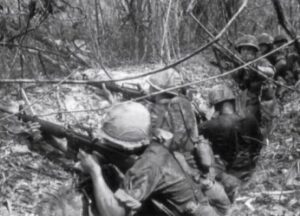
During my first 22 days at Khe Sanh, at any given time, three to five platoons, sometimes mine, patrolled the thirty square miles of the surrounding hills, mountains and valleys. We saw traces of the enemy but never made contact. Unbeknownst to us grunts, Marine intelligence knew that thousands of NVA surrounded Khe Sanh.
At 0500 on 21 January, I woke up to a series of extremely loud explosions that shook the ground beneath us. Terrified, I threw myself off my cot and tried to disappear into the dirt. NVA heavy artillery was pounding Khe Sanh. The siege had begun.
Lieutenant General Robert Cushman, at that time the top Marine in Vietnam said: “Digging is not the Marine way.” Somehow, digging-in seems like a soft thing to do; fighting from a hole is like fighting on your knees. So, most of the defenses against the NVA artillery were built after the heavy shelling began. On the first three days of the siege my platoon dug our deep, long trench line, and built our first bunkers, hovels so inadequate and crowded that I for several nights chose to sleep on a cot in the open air.
We were surrounded by as many as 40,000 NVA. Despite the continuous incoming, many hundreds of Marines were flown in to reinforce KSCB. Eventually nearly 5,000 Marines occupied Khe Sanh and the hills and outposts. During the siege, one unit, Alpha Company of the 1st Battalion, 9th Marines, known as “The Walking Dead,” took extremely heavy casualties. On 8 February 1968, its first platoon was practically annihilated during the battle of Hill 64.
On 25 February my reinforced squad was ordered to stand watch in Bravo Company’s trench line while a Bravo platoon left the base to patrol NVA held territory. Suddenly, about 500 meters away, an intense fire fight erupted, M16s and AKs chattering back and forth.
From where I was standing, I watched three Marines carry the body of their leader back into the trench line. Moments later, Ed Rayburn staggered toward me, his bloodied face cleaved deeply in half, the two halves wobbling, dangling obscenely. I could not believe he had walked back to us by himself, that he was still alive. I later learned that what remained of his lower jaw was sewn to his chest. After eight years of torment, he killed himself. Ed Rayburn’s face, his blood-cleaved monstrous face, that flapped as he lurched toward me, is the worst memory I have of Khe Sanh.
During Bravo’s intense firefight, 26 of the 41-man “Ghost Patrol” were killed. One man was taken a POW. Nearly all the survivors were wounded. 25 of the KIAs were left behind. Six weeks later I carried the bones and rotted flesh of some of those Marines back to the base.
On 27 January my platoon took our only siege KIA. Frank Uzzell was shot by an NVA rocket propelled grenade while walking point on one of our few patrols outside the perimeter. I was at the rear of the platoon. Under all circumstances, before, during and after the siege, we tried to follow the Marine rule to not clump together.
In a way my platoon was lucky. The NVA’s continuous artillery, mortar and rockets hit our bunkers just a few times. But leaving them, even just to use the latrine, incoming often exploded close by. Those incoming rounds could strike anywhere at any time. During the siege many men in my platoon were hit by shrapnel or suffered severe concussions. Several men were medevacked. Some returned to the platoon. None had limbs amputated or were severely disfigured or maimed.
One good thing about being stuck in a decent bunker at Khe Sanh was that I had a permanent home. That is something a combat rifleman never has. It was in that bunker, which I helped build, that I kept my camera, film, letters, and stationery. I was only a grunt, not an intel officer or public official, but I could feel that we were winning the battle, breaking the siege. For that reason, I mailed my processed black and white film to Kathleen Toomey in Pittsburgh. Kathleen’s brother, Joseph, was my best friend at boot camp. He was killed by friendly napalm on 8 August.
By early April Marine, Air Force and Navy air power, as well as Marine artillery, had killed most of the NVA big guns and surrounding troops; the heavy bombardments diminished.
On 6 April my company mounted an attack outside the wire. In the abandoned and cratered moon landscape we found only the decomposing bodies of dead Marines and NVA.
Nine days later, on 15 April, my platoon was flown from Khe Sanh to a beach near Da Nang for one week of R&R-like guard duty.
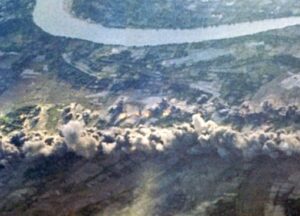
During the 77-day-long siege US forces dropped the greatest volume of explosives in the history of warfare over the thirty square mile sector surrounding Khe Sanh.
My cousin Bengt Nicolson was an avid photographer. When he heard in June 1966 that I was about to move from Sweden to West Africa he advised me to buy a 35mm rangefinder camera with a built-in light meter and a tripod. Bengt quickly taught me basic photography. I still have a nice collection of color slides depicting people, landscapes and animals I saw during my 11 months in Liberia. Taking photos was not a hobby but a way to document certain aspects of my life. I would never have guessed that my photography would play a part in documenting Khe Sanh.
When I flew to Vietnam in the third week of December 1967 the flight had a four-day layover at Camp Hansen, Okinawa, Japan. The abundance of cameras at the base PX was astounding. Having made good money in Liberia, and having furthered my knowledge of 35mm cameras, I purchased a Pentax Spotmatic SLR, which had a built-in light meter, a normal and a short telephoto lens. I also bought several rolls of color and black and white film.
In Vietnam, on the way to Khe Sanh, I took a few photos in Da Nang and Phu Bai. As I settled in with 2nd Platoon on a few occasions I took photographs at Khe Sanh. The most memorable were my photojournalistic shots of a Delta Company boxing tournament. This was on 7 January. Two weeks later all hell broke loose.
Here I was, a Swedish citizen who had volunteered for the American USMC, now assigned to a remote combat base surrounded by 40,000 hellbent NVA. My adventure had truly begun. I must say that consciously and otherwise I was determined, somehow compelled to document the siege. Before my severe head wound affected my brain, I had a pretty high IQ. I was practical and I was in very good physical shape. And I knew the basics of photography. It may sound hard to believe but the incoming shells didn’t frighten me. Instead, by their intensity I calculated my chances of not being hit. Some have wondered why there are no people in many of my photographs. Because they were taking cover while I didn’t.
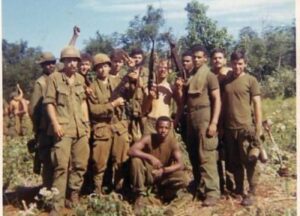
On the second or third tumultuous day of the siege I took a few photographs of my platoon. In February and March, when not standing watch or in other ways protecting the combat base, I spent several days walking and photographing wherever I liked.
Initially on helicopters, C-123s or C-130s, in January, February and March during the siege I sent my exposed color film to be processed in Tokyo; the black and white film to Saigon. The developed film was returned to me at Khe Sanh. Because of its priority, if not lost or destroyed we always received our mail. In February and early March, I mailed my color slides to my parents in Stockholm, Sweden so that they could see a bit of what I experienced.
When the encirclement was broken in early April and my unit was flown to Da Nang, my camera and unexposed film were transported to battalion headquarters at Phu Bai. I never saw either again.
Two months later, on 7 June, my platoon walked into an NVA ambush. We took heavy casualties. I was so severely wounded by shrapnel, and bullets in my head, neck and chest, that my comrades thought I was dead. When the wounded were picked up for medevac someone saw me move, and I was hauled onto a chopper. In the rear, once stabilized, I was medevacked to the States.
It wasn’t until many years later that I reunited with some of the members of my platoon and learned more of the surreal nature of the siege. Having been a rifleman at the continually bombarded KSCB I’d been fighting for no one but the guys in my platoon. These men, our sergeant, and a second lieutenant, younger than I, meant more to me than words can tell. I didn’t know anyone else. Living in bunkers isolated us. I only knew my platoon.
Following my medical evacuation to the states and my months of recovery, in April 1969 I moved into an apartment in Washington, DC, where my parents and Kathleen Toomey mailed the film I’d sent them a year earlier. Some films were missing and some were severely damaged. Only 40 color slides and 150 frames of black and white negative film were worth saving. Better than nothing, I thought—under the circumstances I could have lost everything.
Five and a half decades later, by serendipity, I recently unearthed those 150 black and white negatives. Using a top-of-the-line 35mm film scanner I managed to digitally edit and retrieve about 40 good photographs. The actual film of some of the images is still slightly damaged, either physically, or by light that had entered the film’s canisters. But here they are, 37 photos, recovered from the past, my very personal eyewitness account of the siege of Khe Sanh.
________________
_____________________
wikipedia / The Battle of Khe Sanh
The Battle for Khe Sanh / Capt. Moyers S. Shore II USMC
Per Odman’s photos and stories / Medic in the Green Time



Per Odman: My Photographs of The Siege of Khe Sanh
After 14 months and many obstacles, and living for close to a year in Liberia, where I got my Green Card, I arrived at JFK airport in New York. That same day I went to the recruiting station at Times Square, where three weeks later I signed up for two years with the Marines. I arrived at Parris Island in mid-June 1967. I did well in boot camp. Actually, I excelled in the rigorous training, the skills we were taught. Six months later, on Christmas Eve, I arrived in Vietnam. What a Christmas present!
Within a few days I was flown to the 26th Marines at the very remote and isolated Khe Sanh Combat Base (KSCB), located near the Laotian border and the DMZ. The weather was continuously cold and misty. Soon enough my 2nd Platoon mates of Delta Company, 1st Battalion nicknamed me Swede. Together with two other battalions of the 26th, two batteries of the 13th Marine Artillery Regiment, many supporting Marine units, and some Navy, Army and Air Force troops, 3,000 Marines fanned out over the large base. Khe Sanh had only one bunker, a remnant of the French occupation, used as the Marines’ regimental command post. The indispensable 1,300-yard airstrip ran almost the length of the base.
During my first 22 days at Khe Sanh, at any given time, three to five platoons, sometimes mine, patrolled the thirty square miles of the surrounding hills, mountains and valleys. We saw traces of the enemy but never made contact. Unbeknownst to us grunts, Marine intelligence knew that thousands of NVA surrounded Khe Sanh.
At 0500 on 21 January, I woke up to a series of extremely loud explosions that shook the ground beneath us. Terrified, I threw myself off my cot and tried to disappear into the dirt. NVA heavy artillery was pounding Khe Sanh. The siege had begun.
Lieutenant General Robert Cushman, at that time the top Marine in Vietnam said: “Digging is not the Marine way.” Somehow, digging-in seems like a soft thing to do; fighting from a hole is like fighting on your knees. So, most of the defenses against the NVA artillery were built after the heavy shelling began. On the first three days of the siege my platoon dug our deep, long trench line, and built our first bunkers, hovels so inadequate and crowded that I for several nights chose to sleep on a cot in the open air.
We were surrounded by as many as 40,000 NVA. Despite the continuous incoming, many hundreds of Marines were flown in to reinforce KSCB. Eventually nearly 5,000 Marines occupied Khe Sanh and the hills and outposts. During the siege, one unit, Alpha Company of the 1st Battalion, 9th Marines, known as “The Walking Dead,” took extremely heavy casualties. On 8 February 1968, its first platoon was practically annihilated during the battle of Hill 64.
From where I was standing, I watched three Marines carry the body of their leader back into the trench line. Moments later, Ed Rayburn staggered toward me, his bloodied face cleaved deeply in half, the two halves wobbling, dangling obscenely. I could not believe he had walked back to us by himself, that he was still alive. I later learned that what remained of his lower jaw was sewn to his chest. After eight years of torment, he killed himself. Ed Rayburn’s face, his blood-cleaved monstrous face, that flapped as he lurched toward me, is the worst memory I have of Khe Sanh.
During Bravo’s intense firefight, 26 of the 41-man “Ghost Patrol” were killed. One man was taken a POW. Nearly all the survivors were wounded. 25 of the KIAs were left behind. Six weeks later I carried the bones and rotted flesh of some of those Marines back to the base.
On 27 January my platoon took our only siege KIA. Frank Uzzell was shot by an NVA rocket propelled grenade while walking point on one of our few patrols outside the perimeter. I was at the rear of the platoon. Under all circumstances, before, during and after the siege, we tried to follow the Marine rule to not clump together.
In a way my platoon was lucky. The NVA’s continuous artillery, mortar and rockets hit our bunkers just a few times. But leaving them, even just to use the latrine, incoming often exploded close by. Those incoming rounds could strike anywhere at any time. During the siege many men in my platoon were hit by shrapnel or suffered severe concussions. Several men were medevacked. Some returned to the platoon. None had limbs amputated or were severely disfigured or maimed.
One good thing about being stuck in a decent bunker at Khe Sanh was that I had a permanent home. That is something a combat rifleman never has. It was in that bunker, which I helped build, that I kept my camera, film, letters, and stationery. I was only a grunt, not an intel officer or public official, but I could feel that we were winning the battle, breaking the siege. For that reason, I mailed my processed black and white film to Kathleen Toomey in Pittsburgh. Kathleen’s brother, Joseph, was my best friend at boot camp. He was killed by friendly napalm on 8 August.
By early April Marine, Air Force and Navy air power, as well as Marine artillery, had killed most of the NVA big guns and surrounding troops; the heavy bombardments diminished.
On 6 April my company mounted an attack outside the wire. In the abandoned and cratered moon landscape we found only the decomposing bodies of dead Marines and NVA.
Nine days later, on 15 April, my platoon was flown from Khe Sanh to a beach near Da Nang for one week of R&R-like guard duty.
During the 77-day-long siege US forces dropped the greatest volume of explosives in the history of warfare over the thirty square mile sector surrounding Khe Sanh.
My cousin Bengt Nicolson was an avid photographer. When he heard in June 1966 that I was about to move from Sweden to West Africa he advised me to buy a 35mm rangefinder camera with a built-in light meter and a tripod. Bengt quickly taught me basic photography. I still have a nice collection of color slides depicting people, landscapes and animals I saw during my 11 months in Liberia. Taking photos was not a hobby but a way to document certain aspects of my life. I would never have guessed that my photography would play a part in documenting Khe Sanh.
When I flew to Vietnam in the third week of December 1967 the flight had a four-day layover at Camp Hansen, Okinawa, Japan. The abundance of cameras at the base PX was astounding. Having made good money in Liberia, and having furthered my knowledge of 35mm cameras, I purchased a Pentax Spotmatic SLR, which had a built-in light meter, a normal and a short telephoto lens. I also bought several rolls of color and black and white film.
Here I was, a Swedish citizen who had volunteered for the American USMC, now assigned to a remote combat base surrounded by 40,000 hellbent NVA. My adventure had truly begun. I must say that consciously and otherwise I was determined, somehow compelled to document the siege. Before my severe head wound affected my brain, I had a pretty high IQ. I was practical and I was in very good physical shape. And I knew the basics of photography. It may sound hard to believe but the incoming shells didn’t frighten me. Instead, by their intensity I calculated my chances of not being hit. Some have wondered why there are no people in many of my photographs. Because they were taking cover while I didn’t.
On the second or third tumultuous day of the siege I took a few photographs of my platoon. In February and March, when not standing watch or in other ways protecting the combat base, I spent several days walking and photographing wherever I liked.
Initially on helicopters, C-123s or C-130s, in January, February and March during the siege I sent my exposed color film to be processed in Tokyo; the black and white film to Saigon. The developed film was returned to me at Khe Sanh. Because of its priority, if not lost or destroyed we always received our mail. In February and early March, I mailed my color slides to my parents in Stockholm, Sweden so that they could see a bit of what I experienced.
When the encirclement was broken in early April and my unit was flown to Da Nang, my camera and unexposed film were transported to battalion headquarters at Phu Bai. I never saw either again.
Two months later, on 7 June, my platoon walked into an NVA ambush. We took heavy casualties. I was so severely wounded by shrapnel, and bullets in my head, neck and chest, that my comrades thought I was dead. When the wounded were picked up for medevac someone saw me move, and I was hauled onto a chopper. In the rear, once stabilized, I was medevacked to the States.
It wasn’t until many years later that I reunited with some of the members of my platoon and learned more of the surreal nature of the siege. Having been a rifleman at the continually bombarded KSCB I’d been fighting for no one but the guys in my platoon. These men, our sergeant, and a second lieutenant, younger than I, meant more to me than words can tell. I didn’t know anyone else. Living in bunkers isolated us. I only knew my platoon.
Following my medical evacuation to the states and my months of recovery, in April 1969 I moved into an apartment in Washington, DC, where my parents and Kathleen Toomey mailed the film I’d sent them a year earlier. Some films were missing and some were severely damaged. Only 40 color slides and 150 frames of black and white negative film were worth saving. Better than nothing, I thought—under the circumstances I could have lost everything.
Five and a half decades later, by serendipity, I recently unearthed those 150 black and white negatives. Using a top-of-the-line 35mm film scanner I managed to digitally edit and retrieve about 40 good photographs. The actual film of some of the images is still slightly damaged, either physically, or by light that had entered the film’s canisters. But here they are, 37 photos, recovered from the past, my very personal eyewitness account of the siege of Khe Sanh.
________________
_____________________
wikipedia / The Battle of Khe Sanh
The Battle for Khe Sanh / Capt. Moyers S. Shore II USMC
Per Odman’s photos and stories / Medic in the Green Time